How does a tour agency use intusell? A daily operations guide
Training is done; now it's time for operations. From a tour inquiry in the DMs to a booking, from payment to handing off to a human — a tour agency's daily flow with intusell.
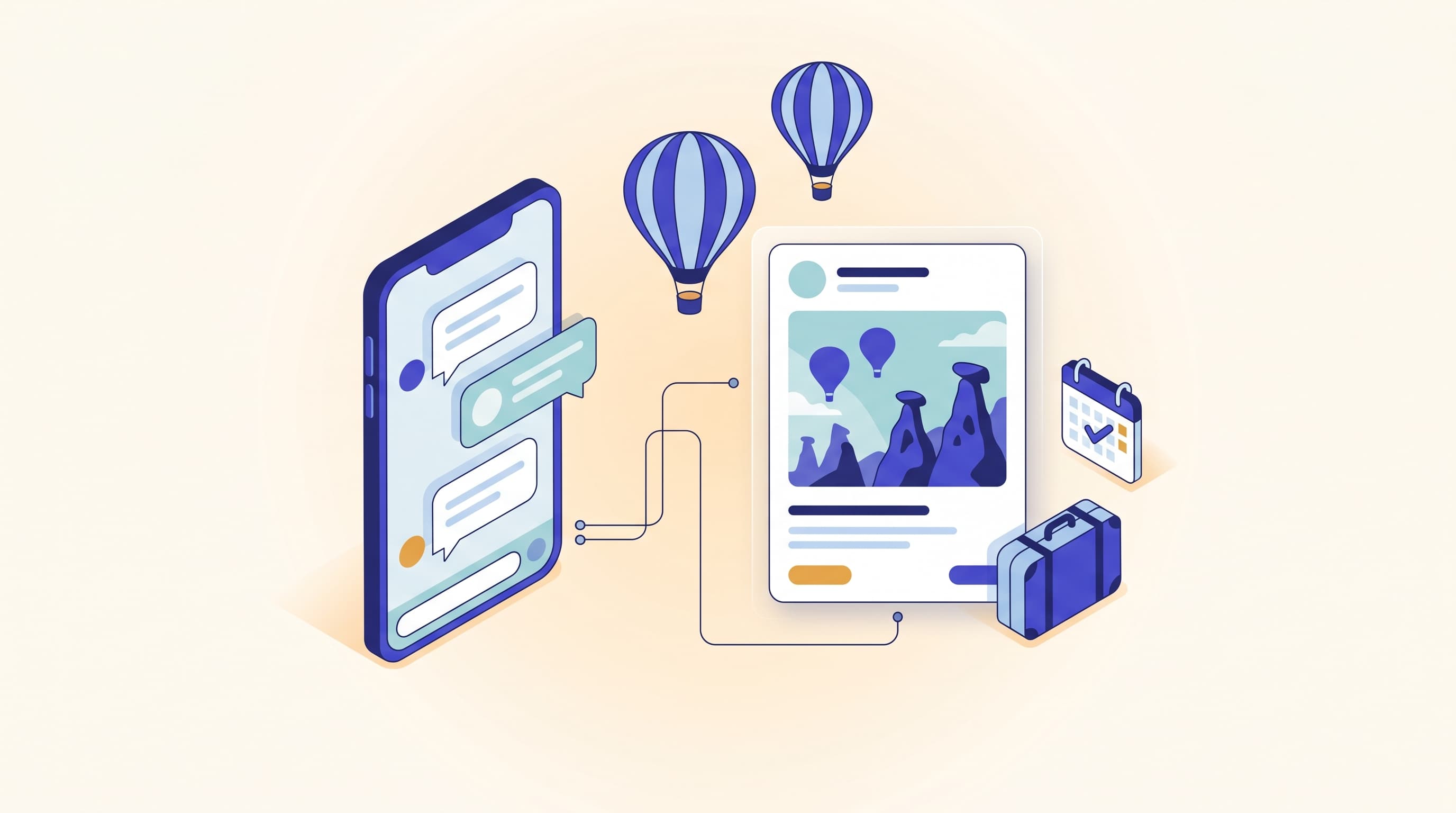
In the first article, you trained the intusell AI: you uploaded your knowledge base, marked your sales conversations, and configured the persona and response rules. Training was a one-time setup. Now the real work begins: how does a tour agency use intusell — that is, how does a tour agency's day-to-day use of intusell actually work? This article walks through, step by step, what the assistant you trained does in the field over a full workday — from the incoming DM to a booking, from payment to handing off to a human.
This article is the second part of the tourism section of our sector-by-sector "how to train your AI" series. The first part, how to train the intusell AI, covered the setup; this one covers turning that setup into daily operations.
Quick answer
A tour agency uses intusell to give automated quotes 24/7 for tour requests customers ask via Instagram DM and WhatsApp, to present the correct price — including child/infant — from the price matrix, to hold an option and reserve a seat, and to route payment to the agency. The AI does not invent prices in off-matrix situations; it hands the conversation off to the live team. The seller is always the agency.
A day in the flow
The typical day of an agency that has set up intusell is very different from before. In the old days, the operations lead would come in each morning and go through dozens of unread DMs one by one. Now, the messages that came in overnight are already answered, leads are categorized, and some options are already held. The backbone of a day works like this:
| Time | Customer side | What intusell does |
|---|---|---|
| 02:14 | "Is there a Cappadocia tour in September?" | Suggests a suitable tour, quotes from the price matrix |
| 09:00 | The operations team logs in | The leads accumulated overnight are ready in the single inbox |
| 11:30 | Customer asks for an option | quote → option_hold, seat temporarily reserved |
| 14:00 | Customer makes a payment | awaiting_payment → IBAN details shared |
| 16:45 | Complex visa question | The AI can't find the answer and escalates the conversation to the live team |
| 23:30 | Customer who has gone quiet | Proactive follow-up message, lead kept alive |
The team is now occupied not with scanning messages but with conversations that genuinely require a decision.
Who is it for?
This usage model especially makes sense for agencies that:
- Receive heavy demand via Instagram and WhatsApp — those who can't keep up with dozens of "how much is it?" messages a day.
- Lose after-hours demand — operations that miss sales because they respond late to questions coming in the evening and on weekends.
- Have a fixed product catalog — those who sell Umrah, Hajj, cultural, and holiday packages through recurring questions.
- Manage many channels with a small team — firms forced to track DMs, WhatsApp, comments, and email separately.
If you have a volume of demand that a single salesperson can't keep up with, intusell works like a senior salesperson who meets that demand.
Incoming request: the customer asks about a tour, the AI suggests a suitable one
The flow starts when the customer sends a message. Imagine someone writes via Instagram DM: "We're thinking about a Black Sea tour in November, 2 adults 1 child." The AI reads this message, scans the tour terms in your knowledge base and the packages in your catalog, and suggests a tour that fits the customer's need.
An important point: the AI responds in whatever language the customer writes in. For foreign tourists this is critical — a Cappadocia inquiry that comes in English gets an English reply, with no extra configuration needed.
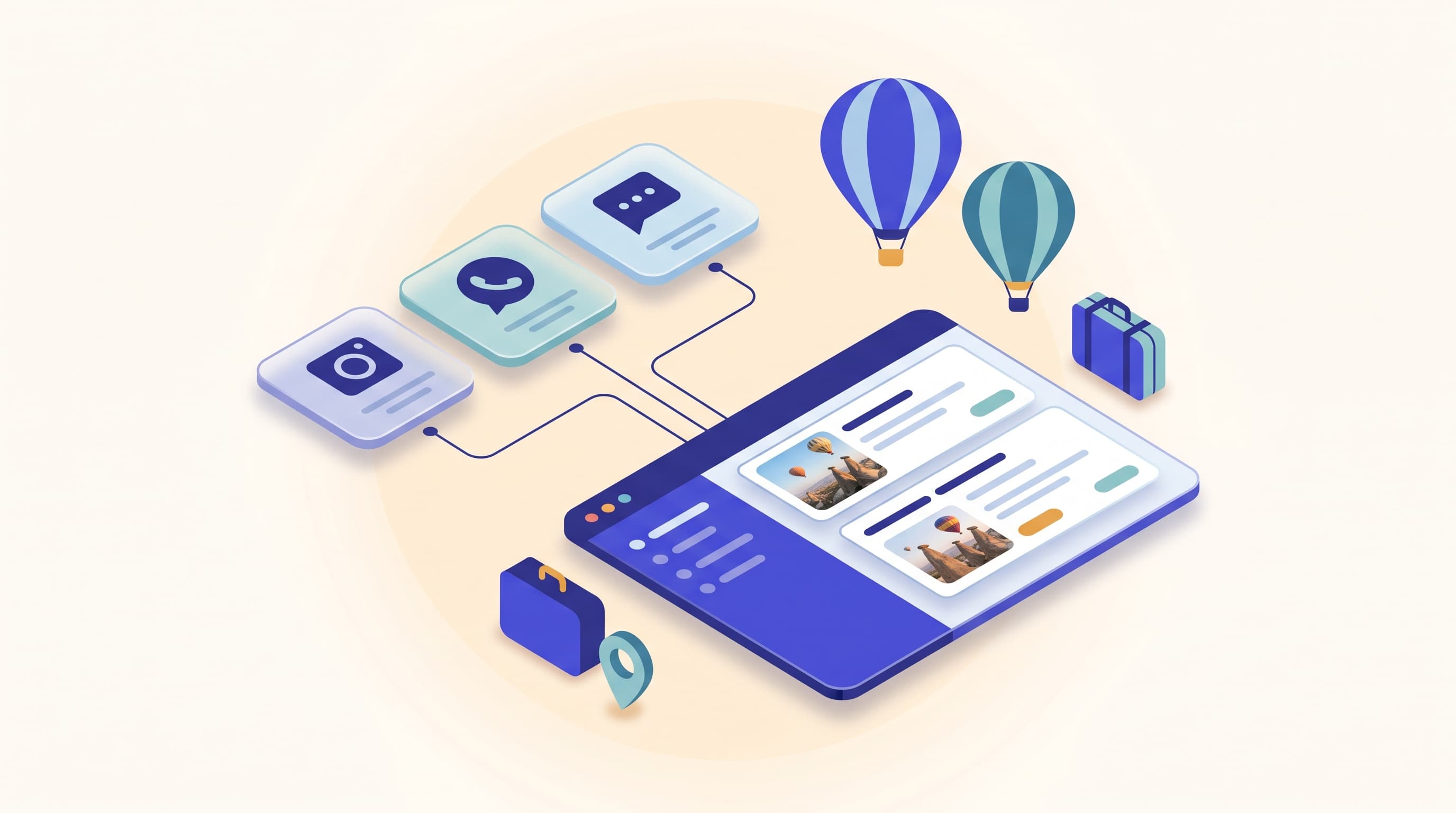
If you added the "ask about the need before quoting" response rule during training, the AI first clarifies the departure point, the date range, and the number of passengers. Thanks to this rule, the quote isn't random; it's based on the customer's real need. We separately explain how all these channels come together in a single inbox in the Instagram and WhatsApp automation article.
Price and availability: the AI quotes from the price matrix
This is the most sensitive point for tour agencies. The AI does not invent the price. It quotes only from the price matrix in your catalog. The matrix works across three axes: departure point × hotel class × room type. Child and infant prices also come from this matrix:
| Passenger type | How it's calculated |
|---|---|
| Adult | Matrix price (departure × hotel × room) |
| Child | Child price if below the age threshold |
| Infant | Separate infant price |
| Single | Matrix price + single supplement |
On a "2 adults 1 child" request, the AI asks the child's age, applies the child price if it's below the age threshold, and gives the total quote in one go. The default currency is USD.
If a combination that isn't in the matrix is requested — for example, a departure point you haven't defined — the AI, instead of inventing a price, suggests connecting the customer to the live team. This behavior prevents you from giving the customer a wrong price and then having to correct it; this is the foundation of trust.
You'll find a detailed account of how the catalog is fed via the KolayTurum SOAP integration or XML, and how the price matrix is built, in the tour catalog and KolayTurum integration article. Thanks to the nightly automatic sync (a cron around 02:00), the matrix stays up to date.
Option and booking: the seat ledger and overbooking
When the customer likes the quote and says "can we reserve it?", the booking lifecycle kicks in. The flow proceeds in a clear sequence:
quote
  → option_hold (option — seat temporarily held)
  → awaiting_payment
  ↔ partially_paid
  → fully_paid
  → confirmed
  → departed → completed
Cancellation, refund, no_show, and waitlist branches are also inside this cycle. The FX rate is frozen at the moment of the quote — meaning the price you gave the customer stays fixed for that quote even if the exchange rate fluctuates.
When an option is held, the seat ledger kicks in, and this is mathematically safe: capacity is protected by a database constraint. Overbooking is impossible. Even if two customers want the last seat at the same time, the system sells to only one; the second automatically drops to the waitlist. This eliminates the nightmare agencies working with manual Excel face most often — selling the same seat twice.
Payment: bank transfer/IBAN by default, iyzico optional
When the customer reaches the awaiting_payment stage, the payment step begins. You have two options here:
- Bank transfer/IBAN (default): Requires no integration. The AI shares the IBAN details with the customer; when payment is made, the status updates to partially_paid or fully_paid.
- iyzico POS (optional): If you want to take card payments, you connect iyzico, and the customer pays instantly by card.
In both cases the core rule stays the same: the seller is always the agency. Payment goes directly to the agency's account, and the invoice is issued in the agency's name. intusell never steps in or takes the seller position at any stage. For product and pricing details, see the solutions and pricing pages.
KVKK consent, passenger details, and the contract
As the booking progresses, passenger details are collected. For each passenger, name, date of birth, and passport information are taken; passport and personal data are stored encrypted. The system provides protection on three KVKK-related fronts:
- Explicit consent: Before passenger details are collected, explicit KVKK consent is obtained.
- Contract acceptance: When the customer accepts the tour contract, the acceptance is recorded with SHA-256 hash proof — meaning the "I accepted" claim can be technically proven.
- Encrypted storage: Passport and PII fields are end-to-end encrypted.
This lets you answer the question "what did the customer accept, and when?" with proof in the event of an audit or dispute.
Following up with the quiet customer: proactive follow-up and CRM
In tour sales, most leads dissolve among customers who say "let me think about it" and disappear. intusell doesn't forget these leads. Customers who go quiet after a quote receive a proactive follow-up message; the lead is kept alive. Every conversation is logged into the CRM, so the customer's history, which tour they were interested in, and what stage they're at stay on record.
This way, when you sit down to operations in the morning, it's clear which lead is hot and which is awaiting follow-up. You don't need to keep a manual reminder list.
Handing off to a human: lock modes
You decide how autonomously the AI works. There are three lock modes:
| Mode | Behavior | When |
|---|---|---|
| ai_only | The AI handles all conversations | Busy periods, when you want full autonomy |
| hybrid | The AI runs the normal flow and escalates when needed | Ideal for most agencies |
| human_only | All conversations go to the live team | Sensitive periods, special campaigns |
In hybrid mode, the AI hands off a visa question it can't answer or an off-matrix price request to the live team. At the moment of handoff, the full history of the conversation is in front of the team; the customer doesn't have to explain from scratch. You can change the mode at any time — for example, ai_only during holiday season, human_only in a crisis.
What it isn't
To place intusell in the right category, let's clarify what it isn't:
- It's not a chatbot. It's not a flow bot that answers from preset templates; it's a fully autonomous AI sales assistant that works with the knowledge and sales techniques you trained.
- It's not a booking engine / GDS. It doesn't provide flight or hotel inventory; it uses your catalog and your price matrix.
- It's not a collection agent. Payment goes to the agency's account; intusell is not a seller or an intermediary.
- It's not a tourism-specific priced product. The pricing model is based on messages and voice minutes; it doesn't change by sector. The tour module can be enabled on any plan.
So you don't start with the wrong expectation, let these boundaries be clear from the outset.
Frequently asked questions
Does the AI complete a booking on its own?
The AI quotes, holds an option, and takes the customer all the way to the payment step. Seat allocation, capacity checks, and payment confirmation run in an atomic system. In risky or off-matrix situations, it hands off to the live team. Final approval can always stay with the agency.
Who receives the payment?
Payment always goes to the agency. The default method is bank transfer/IBAN, and it requires no integration. If you wish, you can connect an iyzico POS. intusell is never the seller at any step; the seller and the invoice holder are the agency.
Can overbooking happen?
No. The seat ledger is atomic and capacity is protected by a database constraint. The same seat cannot be sold twice; overbooking is mathematically impossible.
Can a customer be connected to a human?
Yes. In hybrid mode the AI runs the normal flow and escalates the conversation to the live team when needed. In human_only mode all conversations go straight to the team, and in ai_only mode the AI handles everything. You can change the mode at any time.
What happens to a message that comes in at night?
The AI responds 24/7. A tour inquiry that arrives at 02:00 gets a quote within seconds; when appropriate, it holds an option. When you open up in the morning, ready leads and quotes are waiting for you.
Which tour types are supported?
Umrah, Hajj, cultural, holiday, domestic, and international tours are supported. For each type, the price matrix, child/infant pricing, and booking flow run in the same system.
Next step
If you haven't trained your assistant yet, start with the how to train the intusell AI article first — the foundation of this operation is built there. If you want to go deeper on the channel side, you can move on to the Instagram and WhatsApp automation article, and you can see the whole series on the all articles page.
To see live how it would work at your own agency, request a demo or write directly to hello@intusell.com. In a 20-minute session, we open your inbox together and test the first quote in the system.
You read the blog — now see it live.
Test intusell live with your own sector scenario in a 20-minute demo.
Related posts
View all
How does a tour agency train the intusell AI? A step-by-step guide
Instagram DM and WhatsApp automation for tour agencies: answering peak-season volume without missing a beat